Showing posts with label Japan. Show all posts

Tuesday, May 18, 2021

FINISHING SCHOOLS? WHAT ARE THEY?

What's a Finishing School? 

I've often thought the term "finishing" has some negative implications, such as you're through. You're done. Sad.

Finishing School used to be where rich parents sent their daughters to refine their manners and prepare themselves to join Society, perhaps to become debutants, but  "deb" or not, to become the wives of men of means and importance, where socializing and entertaining were part of the lifestyle. When education wasn't emphasized or careers impossible, young women as teenagers were sometimes sent off to these schools without completing high school or the school might offer some classes that could bring a person up to the level where they could run a household or pass today's GED. Although women through the centuries have had intelligence, when marriage and children were the intention it wasn't thought education was important.

Diana Spencer, never a scholarly teen, went. So did Jacqueline Bouvier who became First Lady of the United States and Carla Bruni wife of former President of France,  Nicolas Sarkozy.

Like chocolates, the schools in Switzerland were said to be the finest.

Though young women with advantages and opportunities to socialize with rich people have been exposed to that lifestyle growing up, these schools were meant to further refine and to communicate that they were all grown up and ready to be married.

Now there is only one finishing school left operating in that country and the curriculum has changed because today many women opt for higher education and go directly from prep school to university. There are schools elsewhere though, in London, in Japan.

Finishing is actually, in my opinion, Polishing.

Putting your best forward. Smoothing communication. Removing the rude.

Now, being polished can very much be about your career, especially if you need to navigate the customs of other cultures. This is especially true when a person from Europe or America needs to do business in Japan or China.

There are some variants of Finishing School. In the United States "Charm" school is often a Modeling School. Posture (walking tall, perhaps balancing a book on your head), composure (keeping your hands still and in your lap or your legs together when sitting) and having someone else advise you on fashion, hair, and cosmetics, is key.

I've had associates who went to these schools as teenagers as they did want to try modeling or were going into fashion or hair dressing.

I've regularly met men and women who desperately needed to become less crude. Some were good people but ones who blurted without thinking how insensitive they were being to others. Despite succeeding past their parents, they still told horrible jokes, openly put people down for not having as much as they did or ridiculed disabled people, ate with their mouths open, wore scuffed brown shoes with blue suits, or talked only about themselves. It could be cringe worthy.

Finishing Schools vary on what you might be taught so I've made a list. Please note that men too need the information that's taught. 

Table manners.

How to set a table for casual dining to banquets.

Napkin folding.

Flower arranging.

How to be a host or house guest.

Dealing with delicate situations. (What to say or not say.)

Gifts. What's appropriate.

Running a household. (How to hire and deal with servants.)

What to wear for various sports and events.

Some may include.

Dancing.

Languages.

Skiing.

Horseback riding.

I think people who are encountering those more privileged than themselves tend to repress themselves and observe, following the lead of others around them, in order to learn. My experience is that the very rich from birth like what they like and are not so out to impress. 

Who needs it?

I'd say anyone going into international business or diplomacy. World travelers. Anyone who finds themselves involved in business in foreign countries. Scholarship students to private or elite colleges.

What does it cost? 

Several schools I found on the Internet didn't show their prices, others did. Some went on line for classes during Covid-19 others like Anna Bey's School of Affluence are always on line. A discount price I noticed on one school's web site had cut their price from $1500 to $500. I found one article, from a 2013 Business Insider, called "Wealthy Chinese Women Are Paying $16,000 for 10 Days of Finishing School" by Liz O'Connor.

You can learn some of these things by reading books. Go for the ones published recently.

I decided that I would not link to any schools because I don't think I've ever linked to anything that costs money like this. I'm sure you can do a little research yourself if you're thinking of going.

Missy

C 2021 All Rights Reserved including Internet and International Rights.


Sunday, March 25, 2018

GEISHA ARE FAMOUSLY PRIZED AS WIVES... BUT MISTRESSES DO NOT PREVAIL

Chapter 26 of Mineko Iwasaki's book, begins to reveal the progression of a young woman through her teenage years. After two years as a professional dancer, after years of rigorous classes, it was time for her MIZUAGE, the ceremony of moving up. This is the term used elsewhere for the ritual deflowering for which men compete and bid, depicted in the film Memoirs of a Geisha but which Mineko Iwasaki denies happened to her or in her particular house.  She says it is like "sweet sixteen" in the west. Her Okiya (the household she belonged to) paid for her ceremony which cost over $100,000 just for the right kimono, as well as for things like treats and gifts to be given around the neighborhood. The treats handed out include ones that appear to be breasts with pink nipples. (Not considered to be obscene.)  She was seventeen in October of 1967 when she had hers.

On page 5 of this chapter she says that this ceremony tells the community as well as the clients that she is getting near marriageable age and that geisha are "famously prized" as wives.


EXCERPT: ... "One couldn't ask for a more beautiful or sophisticated hostess, especially if one travels in diplomatic or international business circles.  And a geiko (the term her particular house used, rather than geisha) brings with her the cornucopia of connections she has cultivated over her career, which can be very important for ayoung man starting out..."

But the young geiko is also used to having money. 
Page six:

 "I have seen instances where working gieko married for love and basically kept their husbands.  These relationships were rarely successful." ..."What about the women who are the mistresses of married patrons?  Those stories could fill another volume.  The classic take is that of the wife lying on her deathbed.  She calls the geiko to her side and thanks her tearfully for taking such good care of her husband.  Then she dies, the geiko becomes the man's second wife, and they live happily ever after.

It is rarely that straightforward.

I remember one particularly disturbing incident.  Two gieko were having affairs with the same man, a big sake merchant.  They each took it upon themselves to pay uninvited visits on his wife to implore her to separate from him. Caught in the impossible dilemma of the ensuing uproar, the man committed suicide..."


Wednesday, March 21, 2018

MINEKO IWASAKI as MISTRESS GEISHA of FAMOUS ACTOR SHINTARO KATSU

Chapter 28 of Mineko Iwasaki's memoir is where we begin to find her tale of her geisha mistresshood to a famous married and much older Japanese actor, stage name Shintaro Katsu.  Remember that an arrangement like this was socially acceptable in Japanese society where marriages were arranged and not for love, and even desired by the geisha, who needed to think about a future for herself as she aged. We must realize that geisha were not expected to remain virgins, and as Mineko says, when you put beautiful, accomplished, charming, women and powerful rich men together something is bound to happen.

I'll reiterate the story for you.

Mineko and Shintaro, who she called Toshio, were introduced when she was a fifteen year old professional dancer, no big deal, and then reintroduced when she was 18 and considered marriageable. Mineko, because of the attempted rape she had suffered at twelve, had doubt that she could allow physical love.  She even thought that her inability to love effected her dancing.

It turns out that Shintaro Katsu was the first man to kiss her and her reaction was not positive.  She says she thought kissing caused pregnancy! (This was the late 1950's.)  She was outraged that he had taken advantage of the two of them passing each other on the stairs, and reported this to her house and begged off having to entertain him. She was encouraged to give him slack because he was a good customer. He wished to seduce her gradually, but she gave him a challenge.  She said that if he showed up at Gion Kobu for three years, then she would succumb.  She was not always there but this he did.
He said that love and marriage do not always go together. He said he wanted a divorce.  He was twice as old as she and had children.  She voiced her objections.  But he won her over, gradually becoming one of her favorite customers.

And so she began a life of continuing to dance and being honored as the greatest dancer of her generation in Japan, but also traveling with Toshio.


EXCERPTS: Chapter 31, pages 5, 6 of 25 of the e-book.

"The "flower and willow world" is a society apart, complete with its own rules and regulations, its own rites and rituals.  It allows for sexual relationships outside of marriage, but only if those relationships adhere to certain guidelines... Thus Mother Sakaguchi arranged my apprenticeship to the iemoto and remained ready to intervene whenever there was a problem...Toshio promised Mama Masako that he was going to divorce his wife...

Page 13: "Toshio sounded on the edge of despair.  he talked to me for hours.  About his wife.  About his children.  About his anguish over the whole situation. I was too concerned about him to think about myself...

Page 14: "I will stay with you as long as it takes to convince her.  But you have to promise me two things.  You will never keep secrets from me and you will never tell me a lie.  If you do, it's over.  No questions asked. You'll go your way and I'll go mine." 

She went with him to New York City.

Mineko found herself surprised by her lusty passion.
Page18: "I was madly in love, and the intensity of our passion made a profound difference in my life.  More than anything else, it affected my dancing, which attained the expressiveness I had been seeking for so long.  Emotion seemed to flow from my heart into every movement, every gesture, making them deeper and more powerful."

In 1973 during another trip to New York Toshio introduced her as his fiancée at a party.
Back in Japan, though he had homes in Tokyo and Kyoto, her apartment became their "love nest."  She reports that he actually enjoyed doing the cleaning.  As her schedule was still very busy, for she had not retired her dancing, she had no time for domestic duty.  In fact she had moved back into the okiya in 1972 because she couldn't deal with cooking and cleaning.

Chapter 35, pages 1-3, 10-12. 16 of 27

EXCERPT: "For five years I believed that Toshio was going to divorce his wife and marry me.  During this period he lied to me twice. ... (He spent time with his wife.  His wife and children met him at the airport.) ... I know I said in the beginning of our relationship that lying was unacceptable but life is not so simple.  ...

Toshio lied to her twice, both times the lie had to do with spending time with his wife. He had her exit a plane separate of him when his wife and children were there to meet him.  Finally, after five years, she decided to end it after in March 1976 he lied to her a third time. This time his wife was with him at a hotel she had planned to stay at with him.  He lied that he was in meetings but she entered the room he was staying in and found herself relocated to another room.  Then she saw his wife's fur coat and bag.   Mineko went crazy, dumping the contents of the bag and putting a knife through a heap of clothing.  Then she packed her bags and left him.

Now if you are wondering if Toshio's whole family was on the side of his wife, they were not. In May of 1976. she went on a family trip that included his parents, his brother and brother's girlfriend.


EXCERPT: ..."It was not considered strange that I was traveling with this artistically accomplished group. His parents valued the cachet that I brought, as a geiko, to the party and were happy to include me in their circle.  They approved of my relationship with their son and we were quite fond of each other,"

Then she went to her house and informed Mama Masako that she wanted to separate from Toshio.  He was supposedly heartbroken and wanted the relationship to continue, but Mineko was through.


As you read these excerpts, I wonder if you, like me, noticed that this wealthy and famous man who owned homes allowed the affair to continue at her apartment.  It seems to me that he should have bought her a house rather than allow her to continue living in an apartment that she needed to afford.  - Missy


Saturday, March 17, 2018

MINEKO IWASAKI on LIVING AMONG OTHER COMPETITVE GEISHA

MINEKO IWASAKI


Chapter 25 pages 4-5 of 36 of the e-book  EXCERPT:


"It's hard to imagine living in a world where everyone - your friends -  your sisters - even your mother - is your rival. I found it very disorienting.  I wasn't able to distinguish friend from foe.  I never knew who or what to believe.  Inevitably,  all of this took a psychosocial toll and I began to experience emotional problems.  I suffered periodic anxiety, insomnia, and difficulty speaking."

Mineko writes that in Japanese culture, harmony is the most prized way of living.  A peaceful co-existence is emphasized.  Everyone is to get along and especially so when a geisha.  She must learn to communicate with everyone even if she does not like them, project warmth but without inviting sexual intimacy, to be diplomatic and entertaining.  She is not expected to play dumb.  The geisha and management of the house research the people they will be entertaining so that they will know something about them and what to talk about before they even meet the guests.  They are expected to be humorous, make intelligent commentary, and exhibit some witt.
In her book, Mineko says that she is by nature a shy and private person who does not like people.  Becoming social was a challenge for her and she sees it as a way of overcoming her nature.


Tuesday, March 13, 2018

MINEKO IWASAKI on THE BUSINESS OF BEING A GEISHA

MINEKO IWASAKI


In her memoir of her life growing up to be an entertainer known as a Geisha in Japan, Mineko Iwasaki tells us that balancing a husband and a career is not an easy life, but it is allowed.  Most geisha first retire, then marry.  She sees the life they are raised to live as an independent one.  Women lead the business, keep records and do the bookkeeping (including the cost of lessons in dance and music to provide the woman a professional career and the cost of food and the extremely expensive kimonos) and says that the geisha are out late, often not getting to bed until 3 am.  Around 10 am, the business men who sell things they need come to show their wares.  But no husbands, no men, not even a girl's own father, is allowed where only priests and children are allowed and there in an inner house that is all women, a feminine society. And there is no stigma to becoming a single mother.  But if the geisha has a boy, she must leave the house, while a girl child is welcome as a future geisha.

In Chapter 9, page 13 of 27 of the e-book, she emphasizes that Geisha houses are NOT houses of ill repute. 

In Chapter 19, pages 3 and 4 of 28 of the e-book, she writes
"MISEDASHI, the term used for a moiko's debut, means "open for business" and indicates that the maiko is prepared to begin working as a professional."  (She had hers on March 26, 1965.)

She states that this event is expensive, tens of thousands of dollars, easily over $100,000 is spent!  There is a strong emphasis on kimono.  In Japan there are 28 seasons, each with it's own symbol (I think of this as like a zodiac) and the kimono, obi (sash) and hair ornaments are supposed to reflect the season, which means that a geisha must be able to own or borrow at least 28 different kimono.  The colors and patterns of kimono communicate class, status, and much else. Each geisha has a "dresser," (think of him as a fashion stylist) who dresses her and sees to it that every detail is correct.  So much time is spent with the dresser that they become a geisha's friendly confidant.


Wednesday, March 7, 2018

MEMOIR OF A GEISHA FILM TRAILER

 I loved this film, not only for its artistry but its story, its "reveal" of a life we modern women probably could not imagine. Based on the novel by Arthur Golden, who interviewed Mineko Iwasaki, and he says other Geisha as well, it is assumed to be close to her life story. One of my platonic men friends said that he felt sorry for the girl in this story.

Saturday, March 3, 2018

MINEKO IWASAKI - from GEISHA to MISTRESS OF A FAMOUS ACTOR to WIFE and MOTHER and ARTIST


Born in 1949, Mineko was the mistress of actor Shintaro Katsu, called Toshio, a relationship that went on for several years.


What do we really know about Geisha?

To the point: Are they prostitutes or are they not? The word Geisha translates to artist or woman artist. Girls take classes and train seriously for many years, singing, dancing, playing instruments, conducting tea ceremonies, communicating diplomatically with just about anyone; they are entertaining.  But do they also have to have sex with clients?

The Iwasaki geisha house was a world of women located in the Gion Kobu district of Kyoto, Japan, and according to Mineko Iwasaki, the most famous and traditional kayukai of them all, the place where she spent her entire career, first as a young girl who had to legally choose to be adopted and change her name to the house, then as a Maiko or young dancer, and finally as an accomplished adult woman dancer and entertainer, the most famous who would earn millions of dollars.

But this is what we want to know. Even if they are not sex workers too, aren't they supposed to attract and be kept by a rich patron or two? To become Mistresses? Are they desirable as wives? Maybe the ritualistic aspect of their lives and the emphasis on their artistry and beauty detracts from a form of sexual servitude or sex work?  Or perhaps it depends on how beautiful the woman or how reputable her house or if she is lucky enough to have a loving, very rich patron. Falling in love can be a problem, especially if it is someone who cannot marry you, or cannot admit to knowing you, or who is poor. (Though we are sure the entertaining girl must pretend to very much like a man or love him even if she does not!) 

Having a girl baby is not a problem and single motherhood is not taboo, but having a boy baby may mean going to live elsewhere to raise him.

We learn through films and books that some girls were often given over to this life by parents who could not afford them or who felt there might be a better life ahead for them if they did. The young woman is, we hear, kept innocent of the sexual nature of the life ahead for her.

WHAT WAS MINEKO IWASAKI's experience?

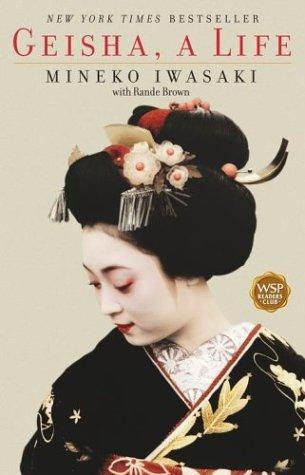
First, I want to get to something that is very important to Mineko and her memoir, called GEISHA, A LIFE.  The film, which greatly impressed me due to its artistry as well as the story, called MEMOIR OF A GEISHA, has a scene in which a geisha's virginity is sold to the highest bidder, as a way of paying back her house for her years of being supported and trained, called misuage. The innocent girl lays back fully dressed in her elaborate kimono and hairstyle and silently awaits what will happen to her.  After this, maybe it's an assumption, but sex might be part of her entertaining.

Apparently, and I say this after reading internet sites and postings around Mineko Iwasaki and her book, is that the author of the novel, Memoirs of a Geisha : a Novel, Arthur Golden, from which the film was based, was sued by Mineko for breaking a verbal agreement to keep her name out of it. He ran her name in a thank you. Both parties were hurt and upset and incredulous. He says he interviewed other geisha or ex-geisha too. One site I read on the Internet said that Mineko had told Golden that her deflowering had sold for $850,000, a record. She was provoked to write her own memoir, you could say to set the record straight.

In her book she denies that Geishas were ever prostitutes or sex workers and makes no mention of her deflowering. Could this be because she never uses the term Geisha on herself, and the name she does use Geiko, is specific to her Kyoto house, in the Gion Kobu district? : maybe in her house deflowerings were not sold to the highest bidder?

Mineko does write in her memoir about being almost raped by her older sister's son when she was about twelve years old, which lead to her older sister's banishment as well as suffering from what we call Post Traumatic Stress Disorder, though she does not use that term.  She also recalls being subject to an attack by drunken men on the street and other attempts at molestation that she fought off vigorously. As I read about her night terrors and having to be closely watched over by others as she slept, I couldn't help but wonder if she was ruined. She felt that this experience and her lifestyle to that point in Japan had done something to her that would make it impossible for her to love or be loved and also that not having experienced passionate love, she could not use that experience in her dancing, which was what kept her going, her love of dance.  Certainly with all that there would be room for admitting to this or not.

It may also be that based on beauty and talent or heritage, that some young women were spared the ritualistic deflowering, which I personally have come to believe happened in at least some geisha traditions or houses, but also that such experiences and rituals do not automatically mean it's the beginning of sex work or prostitution. In other words, having to have sex with men not of one's choosing.

Are Geisha raised to be independent women?  So independent that they do not need men?

In this book, which has a wonderfully simply but eloquent language to it, there is much to learn about the tradition, the opportunity it was, as well as Mineko's own life.  She came from a familyin which old broke aristocracy and more recent business acumen did not support a family of thirteen children.  She was the youngest and the fourth daughter to be given over to the same house.

Perhaps this story is different because it takes place in the second half of the 20th century.

Perhaps there were various levels of sex work, just as there is today in the West.  Certainly the film indicates this, as the beautiful child is separated from her less desirable sister who is being used as a child prostitute with no future ahead of her. In our culture, a woman can be pimped out by a man who abuses her, a child can be sex trafficked or at 18 a woman can work for a legal Nevada brothel and pay for her own college education with the money. There are the super models rumored to charge $10,000 for an evening in Los Angeles and the beauties who work film festivals and - it's said - earn more in a day then some people earn all year.  The question of being groomed for this life or choosing it is a huge one.

Some people think of courtesans as prostitutes', but I think the traditional definition of Courtesans is a bit closer to that of a geisha, though it's said that a courtesan chooses who will Keep her, perhaps both the courtesan and the geisha have a chance of seducing the man they want.

I have the idea that because Mineko Iwasaki, born in 1949 and given the name Masako by her parents, was born to a family with a heritage of nobility and wealthy, unable to afford their large family though they were, that she may have been treated exceptionally well from the beginning.  Indeed she was promised to become the Atotori, or heir to the entire house, worth in the millions of dollars.

But let's get over that  intriguing "did she or didn't she?" question and go to something of possibly more interest here at Mistress Manifesto BlogSpot. Mineko's culture of Japan, where so many marriages were arranged, was quite accepting of a wealthy man having a woman who was or had been a geisha as what we would call a Mistress, a Kept woman.  All her honed talents for charm make for a rather desirable and prestigious Mistress, or Wife.

Mineko writes that she had to force herself to be outgoing and she has long lived quietly as an artist with her artist husband, Jinichiro Sato. 

However she does tell about  first becoming the long time Mistress of a married Japanese actor, stage name Shintaro Katsu, who she called Toshio. Introduced at 15 briefly, and then reintroduced at 18, he persued her after she turned 20.  At the time she was receiving offers of marriage, none which interested her. First she expected him to prove himself to her by showing up at performances every night for three years, which he did!  Having proven his sincerity, she then kept her part of the bargain and became his Mistress. Though there was a protocol of discretion, she traveled with him. He had also claimed he would leave his wife, which he did not.  Mineko finally realized that he was devoted to his wife, as well as possibly having other women as affairs.  She ended the relationship after being humiliated and realizing that she wanted and needed more in a relationship with a man.  She married at age 29 to a man of equal age and she married him very quickly.

The financial aspects of being a Geisha Mistress are usually arranged between the owner of the house, the reigning Atotori, and the man. It was acceptable and she wasted no time worrying about the ethics or morality of it.  A man could have more than one geisha Mistress.  And visa versa. But as time went on, Mineko looked to this man to be true to her.

At the age of 29, she decided to retire at the top of her profession, both acclaimed and wealthy in her own right.  Within her culture and the tradition it was shocking, but Mineko found she wanted more and did not agree with the way things were. She knew she had worked long hours in violation of child labor laws. She wanted the women to be allowed more and better educational opportunities and was disillusioned, considering her life archaic. Dozens of other geisha followed her lead and quit after she did. True to her tradition, she continued financial support of some of the other women of her house as she would have if she had gone on to run it, which had been the plan all along. 

Then she met and married - less than a month after meeting him, the artist, Jinichiro Sato, whose work she was taken with, and lives the life of a wife, mother, householder, as well as a professional artist herself.

Throughout this month, I will feature some excerpts from Mineko Iwasaki's memoir, her own words, focusing on the interplay of women and men in the life she lead as one of the most famous geisha in modern times.

Of interest to my readers is that one of the men who came to see her was someone I wrote about last summer, Aldo Gucci, who was in Japan on fashion business.  In chapter 29, page 18 0f 25 of the e-book, she tells that he ruined her kimono when he signed the red silk with a "flourish of black ink." She hoped to give him the kimono one day since she paid between $5000 and $7000 for a kimono!


C 2018 Mistress Manifesto Blogspot All Rights Reserved


Interested in other "Asian" Mistresses?
Check out these women in my archives!


Evey - Mistress of singer songwriter James Taylor - June 2017
Chinese Empress Dowager CIXI - September 2015
Marilyn Young and Miyoko Watei and the Chess Champ Bobby Fischer - September 2013
May Pang - Mistress of ex-Beatle John Lennon - April 2012


or use a word search such as Japan
And to learn more about Aldo Gucci, who had daughter Patricia Gucci with his mistress, Bruna Palombo, our Mistress of the Month in August 2017.