Showing posts with label San Francisco. Show all posts

Tuesday, October 21, 2025

NORA MAY FRENCH AND HARRY LAFLER : A WINDOW INTO HIS BOHEMIAN WORLD OF SAN FRANCISCO

Excerpt page 81: Then Harry Lafler entered her life. He seemed to offer a window into another world. He was one of the writers who frequented Coppa's, the restaurant at the center of San Francisco's thriving art scene. Poets and painters gathered at a table near the back, dining on sand dabs and green salads and drinking cheap red whine while talking into to the night. Everyone in California had heard of Coppa's. Every arist or writer who visited San Francisco stopped there. And Lafler was painted onto the very wall. .... Harry was at Coppa;s almost every night, writing and then reading his sonnets. He was most often in the company of George Sterling, whom they all called "The King Of Bohemia" because he had defined Bohemianism for the world.  

There are two elements, at least, that are essential to Bohemianism,"he decreed. "The first is devotion or addition to one or more of the Seven Arts, the other is poverty."

Nora realized she had never even seen what Harry Lafler looked like and that it was ridiculous to have developed such strong feelings for him because of a correspondence. However, they had an affair and after she commit suicide it was suggested she was pregnant by him.

C 2025 Mistress Manifesto

All Rights Reserved including Internet and International Rights


Sunday, October 12, 2025

READING THE POETRY OF NORA MAY FRENCH on PROJECT GUTENBERG

 Here's the link! PROJECT GUTENBERG : POETRY OF NORA MAY FRENCH


FROM forest paths we turned us, nymphs, new-made,
And, lifting eyes abashed with great desire
Before high Jove, the gift of souls we prayed.

Whereat he said: “O perfect as new leaves
New glossed and veined with blood of perfect days
And stirred to murmured speech in fragrant eves,

“Still ask ye souls? Behold, I give instead
Into each breast a bird with fettered wings,
A bird fast holden with a silken thread: ........

( read the whole poem at the link!)

Thursday, October 2, 2025

BOHEMIAN POET NORA MAY FRENCH : AN EARLY 20th CENTURY LOVE GONE WRONG STORY OF MONTEREY CALIFORNIA : THE CYANIDE LOVE TRIANGLE


NORA MAY FRENCH
 1881-1907
photo from Wikipedia
identified as Nora May French as photographed by Arnold Genthe


The Gilded Edge by Catherine Prendergast is a primary reference for this month's posts.

Was it actually a LOVE TRIANGLE

I think the subtitle of 'The Gilded Edge' which is 'Two Audacious Women and the Cyanide Love Triangle That Shook America' is a bit unfair. 

The three persons were: Nora May French, a turn-of-the-century poet who was talented and esteemed, but who seems to have disappeared from American Literature, and a young woman though she had emerged as a brilliant poet before her death. Carrie Sterling, married to George Sterling, whose own ambitions were not literary but who, through her husband, met and tangled with some of those, such as writer Jack London, who the Literary Canon well knows, as well as their women. Carrie often played hostess and was the wife who would stick with a bad marriage for a long time since there was social status to be mindful of. George Sterling, who was instrumental in the establishment of Carmel as an artists colony through his role as real estate agent, but who would much rather have made his living as a poet himself; My take on George is that he was alcoholic and a womanizer and not all that well psychologically. But was Nora May French to blame? 

George went out of his way to try to convince people to move to Carmel, a small town in the Monterey Bay, south of San Francisco. He encouraged group photos that made some of these artists and writers look cozy and implied they were moving there or buying real estate as a marketing strategy but not the whole truth. The big names never bought in and he struggled for acceptance by them in part because his talent as a poet never equaled theirs. History may be a bit more fair to the struggling George than this author, for he was a founder of the Bohemian Club, which is now the notorious Bohemian Grove.

These three people were not in a triad and they did not commit suicide together, but I bet because of the title of the book you thought so.
 Although it's complicated, I wasn't convinced that the suicide of Nora or that of George's wife, Carrie, or the eventual suicide of George was entirely motivated by relationship frustration or loss of love. Rather it was also about money - the natural need for it in this material world - and especially so for women at a time when few could support themselves; imagine any poet at any time thinking their poetry would bring in money enough. George Sterling was a founder of the Bohemian Club which endures to this day as the Bohemian Grove, but he eventually went broke.

To her credit, author Catherine Prendergast, did some difficult investigative research to bring us Nora May French, who did indeed commit suicide by cyanide in 1907, and whose poetry - and very mood - inspired copycat suicides! We know that because some of those who commit suicide did so with copies of her poetic verses on them!

Nora's end at the age of twenty-six made her infamous. Headlines remarked on her talent and beauty, calling her witty, spirited, and talented. So the media as it existed decades ago implied there was not just a shame but a mystery. There was a lot of blaming among the men who had affairs with her and it seems Nora was pregnancy prone too.

Why is so little about Nora May French preserved?  Was it because of her sad end or because she was a woman? Prendergast sees the difficulty in this research a problem of sexism. 

As I read this book from cover to cover, I couldn't help but think about the way marriage was about the only way a woman could survive back in the day. Nora May French was not the first or last woman to ever have sex before marriage or an affair with a married man/men, but she needed marriage. Society was not set up for most women to be independent of men or to earn their own money and support themselves and Nora's experience with paid employment was unfulfilling and exhausting. What any woman with creative talent, such as a writer who needed to write, was a patron or a husband rich enough to support her so she would not have to work for income herself and could keep writing. He had to be the type who didn't want a conventional wife and be someone who loved the arts and might find some prestige in having a poet as a wife..

Was Nora so foolish to have sex without marriage and also not have used contraception?  Was that "Bohemian" of her? We don't know if she had access to contraception or not. This story includes abortion. At this time in the United States when abortion rights have been cut in some states, I think about how hard it is was to be a woman with no financial support when a having and raising a child born outside of marriage. The child would be as socially unacceptable as its mother.

Nora had two abortions unmarried, at a time when a woman might, with the right connections to the right doctor, have a "therapeutic" abortion at a hospital, or brew an herbal potion that would cause miscarriage, or understand that some over-the-counter women's remedies sold at the pharmacy were intended to do the same. One was a surgical horror and the other by pills. In both cases she risked not only the ruin of her reputation but that of her family. It seems she very well may have been pregnant again when she suicided.

Nora May French came from a "good" family with ties to some historical persons such as a founder of the Wells Fargo Bank on her mother's side. However, it seems that her father, the son of an Illinois governor, experienced some failures, possibly embezzling money while at a job at a college and, with drought and a stock market crash in 1893, the family fell into poverty quickly. Nora was sent to live with a relative (ironically named Uncle Cash) who might have led her to a good marriage. She lived with him in New York and he sent her to the Art Students League but she had a indiscretion with a man and was sent home. She became the black sheep of her family.

Though she might be on the marriage market without a dowry or any expectation of an inheritance, while working as a seamstress - a lowly profession - in a leather factory, she did promise to marry a young man. 

Excerpt page 54: " ... Working in a leather factory had taken its toll on her body and spirit, Her fingers had grown dull from working the needle into the leather, her eyes strained in the low light, and she found herself too tired at night to think of lifting a pen. Her mind began to slow down, sitting among women who had nothing better to talk about than when they would get married and leave. One morning she woke up and realized that she had become one of them. She couldn't wait to get married and leave.  (Note that she was sewing leather gloves.)

Then Lee proposed. At first, she hesitated She told him everything about herself, how she was happiest wandering in the woods, how she lived to write poems, and how she would never be just an ordinary girl, if that was what he wanted..."

The engagement brought her back into approval of Uncle Cash who sent a money present and her parents relaxed that she would have a husband. However, Lee soon complained of how much time she spent writing and reminded her to prepare to be a wife and mother such as learning to cook. Female relatives of his also pressured her to conform.

In 1904, a month before the wedding, she broke the engagement. At the age of twenty-three she decided she may as well be a spinster. She sent her work out and her poetry was published in newspapers and literary journals. Nora gained a literary reputation. 


Once on the West Coast, a little older but still in her twenties, and already a published poet, Nora was involved in the Bohemian lifestyle, perhaps an experimental lifestyle at best, in which artists, writers sought a break from convention. That said, she got involved with married men and doing so did not prevent her from having sex or heartbreaks.

There was also another man who was interested in marriage with her for a while - or so it was discussed when she became pregnant - retired British Army Captain Alan Hiley of Santa Cruz, California, who was married, and a muse.

She had to live with someone, if not her sister who did not like San Francisco, then a couple such as Carrie and George Sterling. George was connected to the Bohemian lifestyle of San Francisco and also the founding of the Bohemian Club, now called The Bohemian Grove. Instead of just staying  as a house guest of the Sterlings until she married, the end of another opportunity for marriage turned her into more of a permanent guest. It was there at their house that she took the poison.

While Nora did have an affair with George, and he mourned her, he was not her only man.  And while she did use pills to miscarry, she did not take her life immediately after that. Nor was Nora the womanizing George's only affair while married. Carrie Sterling had lost any expectation that her husband would be entirely devoted or satisfied with her. Carrie had thought her marriage to George was advantageous and had to have been disappointed in his character.

Nora commit suicide in 1907 by cyanide.
Carrie commit suicide in 1918 by cyanide.
George commit suicide in 1926 by cyanide.

These suicides were years apart. I just can't call this a love triangle and am not convinced Nora was the reason for the suicides of Carrie or George.

For me, the story of the San Francisco Earthquake of 1906, when estimates are that up to 80% of that city was destroyed, and the resulting influx of refugees into Monterey, and how that influenced the real estate sales was of interest too. People were, like today's homeless, living in tents with their families, sometimes in the backyards of relatives or friends. 

Which brings up my question about Carmel-By-The-Sea and just how "Bohemian" and unconventional it was. You don't have to be artistic or "Bohemian" to be unhappily married or to commit adultery or to have affairs these days. Rather I think the people in this book were stuck in their circumstances including class and status expectations that they be married. Then, there is always the issue of money.


C 2025 Mistress Manifesto 
All Rights Reserved including Internet and International Rights.

Wednesday, June 21, 2023

A BRAVER ANGELS PANEL DISCUSSION PRO AND CON OF PROSTITUTION IN TODAY's ECONOMY

This panel discussion is truly impressive and kept to the standards that I adhere to on this blog. It's well worth the couple hours asked of you to listen to from beginning to end.

These women are Intelligent, respectful of others, other people's personal opinion allowed.  They discuss PTS, AIDS, devastating emotional damage...  Survival in poverty, inability to escape...  Choice?  Victims of predators.  70 percent overlap between prostitution and homelessness. International organized crime in charge. Most prostitutes start at age sixteen before the age of consent.

Focus here is on Mexico - San Diego - Los Angeles - San Francisco.

^^^^^^^^^^^^^^^^^^^^^^^^^^^^^^^^^^^^^^^^^^^^^^^^^^^

^^^^^^^^^^^^^^^^^^^^^^^^^^^^^^^^^^^^^^^^^^^^^^^^^^

Speakers (in alphabetical order): Alex Andrews is a sex worker with lived experience under criminalization of consensual sex work. She is the Director of Woodhull's Human Rights Commission and Co-Founder of SWOP Behind Bars Kaytlin Bailey is a stand up comic and sex worker rights advocate. She is the founder and Executive Director of Old Pros (oldprosonline.org) and the host of The Oldest Profession Podcast Vednita Carter is the Founder of Breaking Free, a non-profit organization based in St. Paul Minnesota, whose mission is to end all forms of prostitution and sex-trafficking. Melissa Farley is a feminist psychologist and researcher who has written a number of articles and two books about prostitution, pornography, and trafficking. She is the founder of the nonprofit Prostitution Research and Education Ursula Ferreira is a queer femme, somatic sex educator, herbalist, and former sex worker with a healing practice in the SF Bay Area Rita Hernandez is the Director of Public Policy and Advocacy for Rescue Freedom International. She is a member of the board of directors of the International Coalition for the Abolition of Prostitution.

Wednesday, June 9, 2021

CLEO DE MERODE TRIES TO TAKE NEW YORK BUT FAILS

Cleo de Merode arrived in New York City in 1896 at the height of her fame in Europe where the Germans and Austrians loved her as much as the French and the first locally taken photos of her appeared in September of that year in the New York Journal.

She had hopes of attaining even greater fame and fortune but she failed. My notion is that perhaps during this era when so many were leaving Europe to immigrate to America and leave behind allegiance to Kings the supposed consort of a King seemed to be just too Old School, from the Europe they left behind. 

According to Michael D.Garval, the author other book on Cleo that was a primary reference for this month's posts, there's the possibility that Americans were merely curious about what Paris thought of as beautiful when they went to see her. They might also have been disappointed in her skills at dance. In New York she presented herself as the star of a ballet called Phryne on Broadway.  Perhaps they were expecting "a spectacle of sexuality" and got classical dance instead and felt disappointed.

Cleo danced at the 1900 World's Fair in Paris when she was twenty-five. (Colorized videos are being posted this month thanks to YouTube contributors.) Watching them it seems to me her presentations were graceful and modest rather than exotic. Was it that her modest performances didn't live up to her racy or sensationalized reputation? Cleo would end her dancing career around the age of thirty-nine, having begun at seven. It was a long run and is still typical of dancers who are often suffering from injuries and arthritis by forty.

Her apparent failure in New York City didn't stop the dancer from continuing on in her tour of America.  She appeared in Los Angeles, Chicago, San Francisco, Boston, and smaller cities in the Midwest.

But then, what did she do until she died at ninety-one?

Had she made a fortune to sustain her? Or had she been given gifts enough to sell? 

Perhaps we will never know the details but the world would hear of Cleo De Merode again long after she had been a star.

C 2021 Mistress Manifesto BlogSpot

My notes from the book on Cleo by Michael D. Garval included

Saturday, February 2, 2019

LOLA MONTEZ : VOLATILE TEMPTRESS and MISTRESS OF KING LUDWIG I of BAVARIA WHO CHANGED HISTORY


youthful image from Wikipedia - Public Domain -
 artist Joseph Heigel painted before 1840
Eliza Rosanna Gilbert -  Lola Montez
born possibly 1818 -1821- death 1861
Also called  Senora Maria Dolores de Porris y Montez 
and a few other names.

A femme fatale of the Victorian age who gained world wide infamy,  the woman most likely born illegitimate to a fifteen year old mother in 1818 as Eliza Rosanna Watson - or Gilbert - in Ireland, was a victim of fake news and gossip like certain celebrities today, even as she caused much real ruckus herself. It seems her nature to have been a spitfire and willing to use notoriety to work her way up to the attentions of a King.  Affairs with Franz Liszt the composer, Andre Dumas Sr., who had left a lot of women with fatherless children, and many others, are probably facts but of short duration. Perhaps "mercurial" or "whimsical" would best describe a woman with a hot temper who would eventually die - most likely - of complications of syphilis.  "Word had it she had taken so many lovers that a centipede couldn't count them on its legs." (page 14)

She was, like many of the women elected Mistress of the Month here at Mistress Manifesto Blogspot, using what she had - beauty - at a time when someone coming from her origins had little opportunity to be more than a wife. Her clear blue eyes were said to shift shades of color and her white skin and black hair were quite the contrast. Considered a great beauty, in some paintings she is, in some images she isn't. Certainly her beauty and youth must have been what captivated her first husband, Lt. Thomas James, whom she married in July 1837 as a sixteen year old (?)who went to live with him in Dublin, then to India. Theirs was a Catholic union that may have never been quite dissolved and could have been a marriage arranged for her by others.

Of this marriage she would come to be quoted thus: "Runaway matches, like runaway horses, are almost sure to end in a smash up."

The author of the book below, James F. Varley, doesn't say how beautiful or desperate her mother may have been, but by 1840 Lola was shipped home to England and said to be locked up in a room.  She had a full on affair with Lt. Charles Lennox of several months duration on the way home.  In 1841, off ship, they went off to London boardinghouse to continue.  But the affair ended.

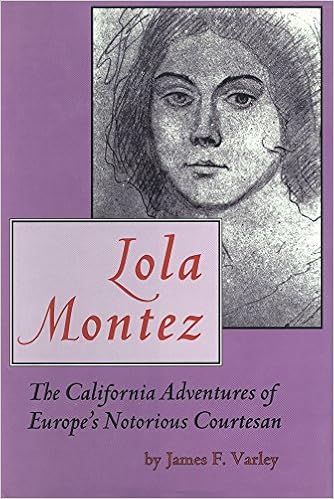
Image result for Lola Montez  James f. varley Primary reference for posts 
on Lola Montez is this book by James F. Varley.

Later in this month I'll get to her California Adventures, for Lola is considered to be part of the history of California and the Wild Wild West in San Francisco and Grass Valley, once a prosperous boom town, but for this first post, I'll focus on what happened in Europe before she decided to travel to the new country. 

Wanting and needing to become financially independent, and inspired by a famous dancer at the time who did "Latin" dances, Lola decided to give dance a try, studying in London with a Spaniard and then going off to Spain, where she called herself Dona Lola Montez, and claimed Maria de Los Dolores was her real name.  She would change names many times in her life in attempts to reinvent herself. She put on a Spanish accent.  She claimed to be a widow.  But by 1848 she was back in England with a story of being widowed in Spain and selling mantillas. Possibly then she was kept by the Earl of Malmesbury. Too bad for her, an audience member outed her as just plain Betty James, the runaway wife of an army man.

She went to Berlin. There she attended a review held by King Frederick William to honor Nicholas I of Russia.  Did her horse bolt right into the parade because of gun fire or did she ride him there to gain attention?  Well, instead of being arrested, she was invited to visit Saint Petersburg. 


Then there was Warsaw, where she met Liszt.  (He already had a mistress for nine years, Comtesse d'Agoult, but Lola had a passionate week with him.)

Then off to Paris, where she was accused of doing a strip tease of sorts by throwing her garters and other clothing items to men. Her affair with Alexandre Dumas Sr, took place there.

She was still considered an amorist rather than a cold hearted man eater at this point. In Paris she even got herself engaged.  But her fiancee soon died in a duel that wasn't even about her.  She mourned.  She testified.  She brawled with another girl in a theater. She moved on.

In 1846, Lola traveled to the Grand Duchy of Baden and met Henry LXXII of Reuss.  They were lovers but she got thrown out for the offense of having walked across his flower bed! Never mind. Soon King Ludwig I of Bavaria, the married father of nine children, then 60 years old to her 29 years, would become her greatest conquest.  It was a conquest that changed history.

Lola was outspoken and let her opinions be known. She was aware of her power over the King. King Ludwig I's goal in life was to make Munich the center of architecture and art and spent lavishly to build and decorate.  But was he really "mad"?  Lola's presence and the King's unwillingness to give her up challenged the social order and his regime. So controversial was she that protests erupted. She was anti Jesuit/Catholic and sided with the Protestants. It wasn't just his family who wanted her out. Other aristocrats wanted the infamous affair to end. 

By 1848 there were student protests and Ludwig closed down the university for a year.  She was involved with a young Protestant noble.  Soon she was denying rumors of orgies while working on the King to give her a title.  |

"He made the Irish poseur Countess of Landsfeld, Baroness of Rosenthal, and a cannoness of the Order of Saint Therese, of which Ludwig's humiliated Queen was the head." page 40  He also demanded she be respected for her new position and that she receive a lifetime income and a new palace be built for her.
The protests against her became violent. Rocks were thrown at the King.  Lola left town thinking King Ludwig would catch up to her snf when he didn't she tried to come back.  Then she went to Switzerland and awaited him.  He didn't show. 

Lola left Munich because he sent her to Frankfurt where 500,000 florints awaited her at the Rothschilds bank.

Ludwig was forced to cancel her citizenship and all those titles.  

To Londen Lola Montez went, there calling herself Marie, Countess de Landsfeld.  She misjudged that the English didn't know what had happened with Ludwig or that they would accept her. She married a new heir - 21 year old George Stafford Heald, who was a decade younger than she.  Bigamy charges followed.  Divorce was highly unusual.  Had her first husband died in India?  As things got complicated the newly married couple left the country and then fled to France. They lived there quarreling for a couple years - domestic violence. He fled to England alone.  She changed her name to La Comptess de Landsfeld Heald.

Though she got money from Heald and had some of what Ludwig gave her, she spent too much.  So in 1851, she decided to write her memoirs, and they were published in Le Pays, serially.  Like other mistress memoirs, the stories may have been an attempt at extortion.

Affairs and rumors of affairs continued.  Finally she took a steamship to America.  Was she revitalized or broken?  When she arrived in New York in December 1851 crowds were there to greet her.  A book had already been written about her.  Broadway embraced her but the reviews of her dancing skills were not good.  Still, she was learning to market herself and manipulate the press... better than she had before.

More to come!

Missy

C 2019 Mistress Manifesto BlogSpot  All rights reserved.


Tuesday, November 20, 2012

LA IS THE MISTRESS CAPITOL OF THE UNITED STATES! TOP TEN MISTRESS CITIES

Ashley Madison site :  MISTRESSES IN THE UNITED STATES "L.A. beat out Washington, DC (take that, Capitol Hill interns!) for the distinction, as well as Dallas, TX, and West Palm Beach, FL, among others. Within the confines of our fair city, the highest percentage of mistresses are concentrated where the wealthy have a lot to spend on their sidepiece dalliances -- in the 90210 zip code.


The founder of Ashley Madison, Noel Biderman, has some profound speculation as to why we're so cavalier about getting involved with married men here in the Southland.

"LA operates on an entirely different plane than most other major cities," he said. "Many women who live there have their sights set on other priorities besides just marriage and family, therefore pursuing a relationship with someone who already has a wife and kids suits their lifestyle perfectly."


Here is how the cities ranked:
1) Los Angeles California
2) Washington DC
3) Phoenix Arizona
4) Tampa Florida
5) San Francisco California
6) Dallas Texas
7) Raleigh (North or South Carolina?)
8) Milwaukee Wisconsin
9) West Palm Beach Florida
10) Louisville Kentucky

Don't personally know of anyone who met their person on the Internet but the Ashley Madison site is supposed to be very popular for women who are looking for a sugar daddy...