Showing posts with label opera. Show all posts

Tuesday, September 9, 2025

VERDI'S OPERA LA TRAVIATA (THE FALLEN WOMAN) IS A TRAGEDY AND THE MOST PERFORMED OPERA IN THE WORLD


Royal Ballet and Opera - United Kingdom, YouTube station, posted this video.
Excerpt:  Richard Eyre;s stunning naturalistic productions contrasts the superficial glamour of the 19th century Parisian high life with intimate scenes for Violetta with Alfredo and Giorgio Germont, culminating in the heart-breaking final act  Verdi's sublime score contains some of his most inspired arias and duets, including Violetta's introspecive 'Ah forse'e lui and hedonistic 'Sempre libera' Violetta and Germont's poignant Act II encounter and Alfredo and Violetta's 'Parigi, o cara', in which they dream of a happy future.

Missy here! 

True love or a crush that would always be unrequited because the one fantasized about has died? Alexandre Dumas The Younger's book inspired by his year long romance with Maria Duplessis spawned plays and this opera, as well as other productions into the present time.

Thursday, June 19, 2025

"MRS. EMMA HART'S" EXTRAVAGENT HOLIDAY IN NAPLES : EMMA IS SIR WILLIAM HAMILTON's NEW HOBBY and SHE LEARNS THE TRUTH THAT GREVILLE IS OVER HER

1786

Naples was the third largest city in Europe after London and Paris and a playground for the rich. There were glamorous parties, operas, exclusive shopping areas and amazing cuisine. A sort of boom town, it was also considered to be built quickly, with gorgeous but controversially colorfully painted architecture. Author Kate Williams compares it to an "eighteenth century Las Vegas" also because people gambled stayed up all night, drank, and womanized. It was a place to let go and get loose, to swim nude or forgo stiff protocols. Emma became Sir William's new hobby, showering her with gifts including a new wardrobe and a horse, and showing her off. However she continued to write to Greville, as though she were only aware of being on a vacation.

Excerpt page 127 : In July, Emma wrote to Greville, eager to share the excitement of her summer holiday.  They had visited Pompeii and Posillipo and planned to sail to the islands of Ischia and Capri.  She has been been bathing daily and her 'irruptions" were gone, leaving her, as she claims, "remarkably fair." Sir William had invited every artist and sculptor in Naples (apart from Mrs. Damer*) to portray her.  One, possibly Elisabeth Vigee-Lebrun, was painting her in a "Bacchante setting, in a turban, a Turkish dress," and she was modeling for another in blue silk gown and a black feathered hat. The young Swiss-German Angelica Kauffman, and two others planned to paint her, and the cameo maker Marchmont would soon carve her head into a stone that could be set into a ring.  Sir William already had five portraits, and he had asked for more from Romney.


Finally in August, Greville told the truth and she was shattered and both admonished him and begged him to take her back. He urged her to be Sir William Hamilton's mistress. Six months later she was still refusing to do so. She was faithful to Greville, her first lover. (The men she had sex with as a sex worker were not.)

Excerpt page 129 : Emma could not believe his hypocrisy. Exploited from the age of fourteen, she had thought that Greville had saved her, and she had grown proud of her hard-won respectability.  As she knew, mistresses tended to be passed on to progressively poorer protectors, and she expected that Sir William would keep her for no longer than a year and then pass her on.

But Sir William also proved to be a good shoulder to cry on. And by Christmas their relationship was an affair. Her letters were full of love and lust for him. He forgot his plan to also have her as a temporary mistress. She found herself more secure than ever but he, like Greville, aimed to make her over and improve her. Emma learned to sing, dance, and play the harpsichord and guitar and her coaches were those who taught the highest in society.
She was often asked to sing at dinners and even received an offer to sing at the opera in Madrid. Exposed to his extensive library of English literature, she read and then began to try to learn Italian. Sir William was proud of her.

C 2025 Mistress Manifesto - BlogSpot All Rights Reserved including Internet and International Rights

*Mrs. Damer was the sculptress who Sir William Hamilton was considering marrying after the death of his wife and whom Emma met when she first visited with Sir William while with the Honorable Charles Greville.

Sunday, October 27, 2024

MARIA CALLAS : LA TRAVIATA : 1958 in LONDON

For those of you unfamiliar with opera, I offer you this link to the three acts which were adapted from a play by Dumas by Verdi.   ENO.ORG - OPERAS LA TRAVIATA


About this time Maria, born in 1923 was in her mid-thirties, still wanted a baby, was married but not happily and would face a difficult divorce.

Saturday, October 26, 2024

THE RAGGEDY END OF A RELATIONSHIP WITH ARISTOTLE ONASSIS and AN OPERA CAREER: MARIA CALLAS' LIFE ENDS AT ONLY FIFTY THREE


This post wraps up the coverage of Lyndsy Spence's devastating book about the life of Maria Callas though you'll have to read all the details I could not possibly include in this month's dedication to the opera star. 

Betrayed by Aristotle Onassis, Maria Callas accepted that it was over with him. He married Jacqueline Bouvier Kennedy and a month later he called her and expected her to pay attention to him. She ignored him and phoned her and then he threatened to drive his car through the gates of her building. So she saw him but remained firm. Though the former First Lady and the Greek Shipping Magnate had a contract that she would spend two nights a week with him (implying sexual agreement) he expected Maria to have sex with him. Maria gathered her strength to consistently reject him.

Callas's career continued to be blotted with interruptions, changes of mind, and various reasons to cancel. She saw that she could not return to the stage because the public would always expect more of her, not less. An extraordinary tragic actress?  Would she shine in a film of Medea? 

A fortune teller told Maria that she would die young but would not suffer. (Her body double's costume caught fire and it was reported it was she! She was also firm in her opinion that her mother and sister were leaches when they called to express concern after hearing of the incident in the media.) For a film she lost weight to go down to130 pounds and also got an eye lift and did her best. Her film debut in 1970 was well received out of respect for her more so than the film. 

It seems that Maria Callas had a harsh awakening but had gained her perspective.

She told reporters that year that Aristotle Onassis had been an addiction and it was over.  Onassis turned himself into the victim and said Jackie made him unhappy and so their dynamic changed and Maria now called what she had with Aristo a platonic passionate friendship. However she was escorted by famous men and gained her more modern and independent outlook, Maria could not give up on the man. Jackie had spent 20 million dollars the first year of their marriage and Aristo was starting to hate his wife, but Maria, who had been with Aristo for nine years, gave in to him again. The marriage contract with Jackie allowed him a mistress!  But when he took up with Jackie again, Maria took an overdose again. She always claimed these were accidental overdoses.  This time the press got word and it was printed in Paris that she had overdosed. She sued to preserve her reputation.

Perhaps at this time Maria Callas' was at the height of her fame. Now the opera star said that she and Aristo were best of friends. Privately she was conflicted about him. She saw that he had a split personality. He said he wanted a divorce from Jackie but was also bound by their marriage contract so he cut her Jackie's allowance and started treating Jackie as he had Maria. Jackie made a life for herself in America as a response.  Maria wanted the world to know how badly Aristo had treated her though.

In 1971 she finally filed for divorce in Italy as a new law had been passed. It was rumored she would marry Onassis, who was also supposed to be filing for divorce. Maria Callas had finally grown into herself, dressed as she wished, wore pants and joked about her fat legs and wore her eyeglasses. Her self-acceptance - self-love - made her stronger to reject Aristo.

She knew some wanted her to come out of retirement and she hesitated and rejected one offer after another for stage and to make films.

She did sing at the Royal Festival Hall in a London Farewell Concert.

You can watch it here.  And as I watched it, I could not help but think that it was almost impossible to believe this woman had lived through so much. Beautiful, graceful and gracious, entirely professional, I can only wish that at some moment in time before her death in 1977, that Maria Callas had a sense of how far she had come and how much she had accomplished. The people around her tormented the perfectionistic Diva but one hopes that she learned to love herself.

Missy


C 2024 Mistress Manifesto BlogSpot   All Rights Reserved including Internet and International Rights.

You may find other posts by searching for Onassis or Kennedy in the Google Blogger search feature!


Saturday, October 19, 2024

MARIE CALLAS : "GOD HAS GIVEN ME TWO BIG CROSSES TO CARRY" : AN UNDERSTATEMENT IF THERE EVER WAS ONE!

In this post I'm conscious of developing some strong opinions about Maria Callas and her life. - Missy

In chapters 14 - 15 of Lyndsy Spence's book, we learn just how horrible the relationship between Maria Callas and Aristotle Onassis was, an on and off again relationship in which he challenged her belief that it would work out in the end with affairs with other women, including Princess Lee Radziwill, the sister of First Lady Jacqueline Bouvier Kennedy, and then Jackie herself. Maria Callas came to realize that the man she called "Aristo" was a liar and manipulator who exaggerated his stories of his dramatic life for effect. This book gives us a devastating account of domestic violence and madness. Why did Maria allow Aristo to treat her with disrespect? He even beat Maria, sometimes badly. Was she so influenced by old Greek attitudes of how men treat women, how husbands treat wives?

In 1962, Maria was thirty-eight and had devoted her life to developing her operatic voice and her career. She wanted to be married to Aristo but was also always conscious of trying to have some control over her public image and the media. He played her like a yo-yo. When she said that God had given her two big crosses to carry, she meant her mother and her husband.  I'd add to that her father, her sister, Aristotle, the media, personalities associated with the opera including competitors, the courts, and people in the record making business, her ongoing struggles with weight and appearance and low self-esteem. There seemed to be no part of her life was peaceful.

Maria Callas began to give less than stellar performances, and to face that her career as a singer would be ending, yet there were options for recording (making records) and the possibility of staring in a film which also faltered. She would give her last opera performance at the age of forty-two.

This began an era in which Onassis wrangled to keep control of the principality of Monaco while Prince Ranier III prevailed. Onassis spun his web of deceit not only on Maria Callas, but on Princess Lee Radziwill, as he aimed to have the ultimate trophy wife -  Lee's sister, Jacqueline Bouvier Kennedy.  Aristo believed that all women had sex for money and it was only a matter of how much.  He gave mistresses bracelets worth thousands as a goodbye gifts. Eventually he would give such a bracelet to Lee.

Maria Callas may have been a hypochondriac or she might have dealt with sexist doctors who made little of her complaints. She had surgeries for abdominal hernias and, in 1963, there's a possibility that she had another pregnancy or abortion, though this may have just been a rumor as she gained weight.

As her Mother continued to create embarrassment for her in order to financially gain from Maria, Maria and Aristo both seemed to have spoken to the media in ways that were not just from concern about reputation, but also to manipulate each other. They were co-dependent in this way and also, eventually, in the use and overuse of prescription drugs. While Mother was clearly unstable and wicked, something I felt conscious of as I listened to the audiobook is that Maria herself is cast as having to live with so much turmoil but is not outright called mentally ill or unstable herself.  I think she was, and I say that conscious of stereotypes of women, strong women, women who have earned their status and money, who are demanding. Was she independent? Emotionally she seems needy and dependent on the approval of Aristo.

Maria would eventually be emotionally blackmailed into providing some financial support to both her parents, and her mother was willing to attempt suicide to accomplish this. However, Maria seems to have been a hysteric; she too would attempt suicide a few times over Aristo.

Staff, including those aboard his ship, the Christina, were aware of Maria and Aristo as a couple, how they went from holding hands to have arguments, how he sailed without her or got her off the ship because another woman was taking a cruise with him. He would sometimes have Maria on board with her rivals, such as Princess Lee Radzwill, and then make a show of ignoring her. He disappeared for long periods of time when he did not contact her. Perhaps one of the most evil things Aristo did to Maria was play on her insecurities about her body, her weight, and her loss of weight, as she likely developed an eating disorder to become thin and then he'd claim to be attracted to bigger women. At one point she was keeping track of what she ate, each gram of food, knowing that the tiny feminine Princess was his ideal. (Actually he liked androgynous  women.) Author Lyndsy Spence writes that Onassis was also a good customer of the prostitutes of Parisian Madame Claude.

Though Maria was capable of self-support and earned well enough to afford Swiss clinic cures, an elaborate and plentiful wardrobe, world travel, and the support of her parents, Aristotle Onassis was significantly richer. Like a Classic Mistress, Maria was gifted a Paris apartment, though she lived with him in his. She wore the clothes he bought for her.  Because her career decline coincided with her desire to be available to Aristo when he called upon her to cruise, she came and went as he wanted, often waiting for his attention. As the press demanded to know where the relationship stood, at different times both Maria and Aristo claimed they would marry and then said it was a joke.

Their relationship was co-dependent. It was also volatile. Aristo provoked Maria and manipulated her. She screamed at him in front of friends and business associates. Before Onassis screaming had been limited to what she wanted out of the operas she performed in. 

Maria lied to herself about her relationship with this destructive and cruel man, who wanted to even the score with Robert Kennedy, the Senator and brother of President John F. Kennedy.  Had Aristo used Princess Lee to get to Jackie? 

Even as he courted the widowed Jackie after the assassination of her husband, JFK, and showed her his private island Scorpios, Aristo did not let Maria go. It's my feeling that her adoration for him was something he needed. 

When her voice cracked during a performance and she started over, Onassis went backstage to congratulate her on her courage. As she attempted suicide in Paris, he found her and walked her around the apartment to keep her alive. But he had provoked her. That was when she found a love letter and gift of jewelry meant for Lee.

C 2024 Mistress Manifesto BlogSpot   All Rights Reserved including Internet and International Rights.

You may find other posts by searching for Onassis or Kennedy in the Google Blogger search feature!

Sunday, October 13, 2024

CIGAR


 Ari Onassis, rich as a Greek shipping magnate,
 was a true cigar aficionado, 
rarely seen without a habano between his fingers.

Saturday, October 12, 2024

MARIA CALLAS : MARRIED TO GIOVANNIE BATTISTA MENEGHINI : FROM SUCCESS IN ITALY TO ARGENTINA : SHE WANTED A BABY MORE THAN HER CAREER

Maria Callas and  Italian, Giovannie Battista Meneghini: The couple were married from 1949 to 1959. They met when she began to succeed in Italy as an opera singer. Giovanni was an older man and quite rich - an industrialist. He took control of her career, gave her love and career support - at least at the beginning, and sent her off to South America, but denied her a child she wanted. In fact, their marriage might not have been sexual. During their marriage, Maria went by the name Maria Megneghini Callas.  

Married in a traditional way, to Giovannie Battista Meneghini, Maria considered herself her husband's property. He remained in Italy when she began her work in the opera in Argentina in 1951. In Italy, early in her marriage, Maria intended to be something of a homemaker, collecting recipes and setting the table. She wanted a baby but Giovanni said to become pregnant would mean loosing a year of her career. She wanted a baby anyway and was reluctant to continue to sing. Still, the opera singer fulfilled her contracts. 

Hard on herself, Maria didn't like her own voice and dowdy looks. She didn't shave her legs. She walked without gracefulness. Her weight continued to be an issue. 

On top of all that self-loathing were the selfish manipulations of her mother and sister. Her mother was typically unsympathetic, accusing her of not caring about her own family. They said she owed the public. Maria's mother continued to emotionally abuse her, claiming that Maria owed it to her to give her "joy." Her father worked various jobs and was accused of being a lay-about by her mother but Maria ignored his faults while her mother hammered the point that he was a good-for-nothing. Then there was her mother's illness and lack of any health insurance. While her parents remained married in name only, Maria dreaded the idea of actually having to live with either of them again. It's clear that they wanted her to not only have a career, but earn the money to support them, and didn't care about what would give her personal joy. Mother wanted a monthly allowance but Maria gave gifts and repaid loans. Mother wanted Maria to buy them a house and upgrade their lifestyle. Her sister's demands added to the pressure. Marie was emotionally blackmailed by her family. She thought her mother was still able to earn herself a living, if only she chose to.

In 1950, Mexico City, Maria suffered heart palpitations, breathing issues, sleeplessness, and other ailments. Was it all psychological?  

Maria Callas would give another decade to the marriage and her career but the tangle of divorce may have been initiated because she met the man she considered, in today's way of thinking, as her soul mate, the one she was meant for : Aristotle Onassis, the Greek born, Argentina based multimillionaire who had worked his way up into shipping. A megalomaniac with disturbing ideas about women and how women should be treated, "Aristo" would increasingly become Maria's reason for living as he career declined.

C 2024 Mistress Manifesto BlogSpot All Rights Reserved including Internet and International Rights


Tuesday, October 8, 2024

MARI CALLAS BECOMES FAMOUS - NAZI OCCUPIED GREECE and THE LIBERATION CHALLENGE HER PERSONALLY : HER ATTITUDE ABOUT LOVE

From Chapter 3 and 4 of Lyndsy Spence's audiobook... My notes!  (In this we learn about Maria's take on love and marriage.)

Maria Callas, living in Greece, was already considered an artist and local star in 1943 when she sang at a benefit concert. Recognize in the streets, there was constant speculation about what man would become hers. She dealt with a seriously dysfunctional family, the demands of her superiors and the jealousy and gossip of her rivals at the opera. It is known that she had a romance with a man who she had known for a year, the son of a multi-millionaire who wined and dined her. Maria, whose sister was a Mistress being Kept by a man who supported her and her mother as well, did not want to feel obligated to return the "favors" in a sexual way. Her career was the most important thing to her. Like all of us, Maria was living through history, and in the Spring of 1944 the Nazi occupiers of Greece owned the National Opera. As she succeeded there were rumors that she was involved with an officer or a collaborator. She was in a terrible position. Sleeping with the enemy could put any woman in danger. Any woman living in that time and place was in danger of rape. The Greeks thought the German women were whores and the Germans were thought by the Italians to be barbarians... In tears due to accusations, she threatened to resign from the National Opera. But in October of 1944, came Liberation when the British and American troops came into Greece and Greece-based groups like the National Liberation Front and National People's Liberation Army took part in getting rid of the Nazi Germans. Dating but nothing serious, Maria, her family - most people, faced one of the worst winters in history.

Despite her career, the budding star was in danger of starvation. Having money didn't help because it was worthless. She saw a man die of starvation in front of her. National Opera members who had been collaborators were executed. Women who were collaborators - or suspected to be - had their heads shaved and were raped as punishment... The National Opera was closed. Then the Communists came into the mix and threatened to kill Maria and her mother and sister.  At one point they were down to a box of beans.

So there was Maria, who had struggled with eating and her weight, starving and afraid. Her mother found a job working as a Greek-English translator. But they were living in the "red zone" a dangerous area, and it was easy to be accused of something and pay the price, fair or not.  They lived without heat or electricity, behind drawn curtains, and burning rags for some heat during that brutally cold winter.  Finally a boy disguised as a vendor came to the house to bring Maria out of the "red zone" and into the British white zone. She left and the boy returned for her mother.  In the "white zone" she was able to wash in hot water and eat.  Though in 1945 peace was somewhat restored half a million refugees came into Athens.

Because Maria Callas was raised without a father in her life, there is speculation that this lead to her looking for a father figure in her romances.  She did begin a romance with an opera star who was about fifteen years older than she but denied going to bed with him.  He was married and already had a mistress as well, with whom he had two children. She was on friendly terms with both his wife and his mistress!  Sexual freedom was not a problem for him but she said she was an old fashioned woman.  In an ethereal way, Maria thought love was a kind of purification of the soul.  When he asked her to be his mistress, Maria declined. As she saw it a man might have more than one woman but a woman only had one man... She said she was not about to take him from two women and that she had to have to love with head and heart and only then could have sex. Her mother had a far away husband and a lover.  Her sister was a mistress. What was to happen for Maria? Despite the limitations that this friendship-romance presented, it ended badly, suggesting that Maria and the man were emotionally passionate.

When Maria was demoted at the National Opera and took a pay cut, something jealous rivals at the opera wanted, she secretly plotted her way back to the city of her birth - New York - and sought to make her dream of performing at the Metropolitan Opera true.

She had been secretly writing with her father since 1942 and when he became an American citizen, so did Maria. So, while she accepted the National Opera of Athens and signed a year contract with them in May of 1946, in August she went to the American Embassy where she was recognized as an American.  Still, she had to fund her travel somehow. So she leased a theater and did a farewell concert to earn the money.  She left with a couple dresses and not a cent in her pocket.  A loan from the United States government paid for her travel.

C 2024  Mistress Manifesto BlogSpot  All Rights Reserved including International and Internet Rights

Saturday, October 5, 2024

MARIA CALLAS : HER TEACHER-MENTOR NEGOTIATES FOR HER BUT INSISTS SHE IS TOO FAT : THE YOUNG MARIA LIVES THROUGH WARTORN GREECE


Chapter 3 of Lyndsy Spence's book, Cast a Diva, delves on the very beginnings of Maria Callas' professional career and with the demands of her teacher-mentor at the Athens Conservatory, where she was as a scholarship student of sorts. Because she still needed income, Maria later stated - though the teacher-mentor later denied this - that lodging with the woman meant paying for the roof over her head with housekeeping and dog walking duties. While the Diva-in-training dreamed of someday singing at the Metropolitan Opera in New York City, where she had been born, her teacher threatened to dump her as a student if she did not improve her appearance. Loose weight, dress better, fix your hair; these were the expectations.  After all, she was being groomed to be a star.

This same teacher-mentor advocated for her to have income from the Greek National Opera, where she was signed for two years. Maria was to have a job - a steady income - and have her voice protected as she studied by not appearing in their productions. It was a way to get her in and expose the student to the behind-the-scene ways of the opera. Her contract was negotiated as she continued to study at the Athens Conservatory and live with her teacher-mentor. The teenager's career was being carefully managed or she was being controlled.

Her first advocate, her mother, Litsa, complained that Maria only spent her income on music, pastries, and ice cream and was out of control of her eating, just as her teacher-mentor arranged for her to have hairdressing, manicures, and dress making. 

Then war interfered in everyone's lives. In late October 1940, when Maria was about seventeen, the Italians invaded Greece and the Greco-Italian War began. Maria and her family thought to flee to Cairo, Egypt, but Maria was an American citizen and not allowed to leave Athens, which was relatively safe. She was called "That American Bitch" as she began to realize her own talent and fight for herself. She did get parts in the opera in Athens, despite her teacher-mentor's pleas that she be "protected." Then World War II began when in 1941 Germany invaded. When there was a bombing and air-raid sirens went off, the sensitive Maria would vomit. They stayed in Athens.

Still under the age of eighteen, having conspired with her mother to lie about her age, Maria did not report to the Conservatory when she was sexually assaulted and almost raped by a fellow student (never identified).  At home her mother was not sympathetic, only mentioning that if he had raped her then she would have had to marry him and end her career.

Such attitudes are crazy-making to us in Western culture in 2024, but are not unfamiliar to all of us who have experienced some form of sexual harassment during our careers. 

Her world was small. At the conservatory other students called Maria fat and ugly and boys teased her as unattractive. Her mother continued to sew Maria clothing. Maria might have been eating out of garbage cans. In the 1941-1942 era there were food shortages, rationing, hunger. The family ate bread. This too could put weight on and gave Maria the appearance she was not famished. Olive oil and potatoes were procured on the black market by the man who was Keeping her sister and the family. There was always rumor about who was a collaborator because someone had food. People began to die of starvation and eat horses and donkeys.

The Nazi's took control of the National Opera and then Maria lost her contract and income. She had borrowed money from them and then later that year she was reinstated and given the opportunity to be an understudy. Those who had been so mean to her were kept out of the loop.

It was snowing and cold and there was no heating fuel.  The Red Cross reported it. Jews were deported from Thessalonika. 

Yet, opera went on, three hundred miles from Athens, in Thessalonika, where there was begging and prostitution. Maria's virtue was suspect.  So was her sister's and mother's.  Were they involved with Italian officers? Maybe Maria fell in love with an officer? Or perhaps Maria simply was gifted and had not succeeded against all odds without being touched? It's believed that she came home with money for singing for the Italians, though her own mother assumed it was from prostitution.

C 2024 Mistress Manifesto BlogSpot   

All Rights including International and Internet Rights.

Friday, October 4, 2024

THE MARIA CALLAS ROSE


Yes, a rose was developed and named after Maria Callas.  
Also known as the Miss All American Beauty
it is described as full had having at least 41 petals,
a hybrid with an intense perfume, 
and a bloom up to six inches.


Wednesday, October 2, 2024

MARIA CALLAS : WE REVISIT THE GREATEST OPERA SINGER - DIVA and MISTRESS OF SHIPPING MAGNATE ARI ONASSIS

Mistress Manifesto, as a Google Blog, began in 2009 and, before I got up to speed, I chose Maria Callas as my Mistress of the Month. These days I feel that this dynamic woman deserves more and better coverage, especially as actress Angelina Jolie chose to portray her in film. So I will repost a couple items from the past and continue on with the book Cast a Diva by Lyndsy Spence, which will be the primary references for this month's posts.

Maria Callas was a famous and esteemed opera singer, some say the greatest, called The Queen of the Opera during her career, who had a soprano voice and three octave range; She is also known for her dramatic vocal interpretations. She was  born in the United States as an American to Greek immigrant parents but thought of as Greek because of her heritage and because the she went back to Greece with her mother and sister as a pubescent teen and there began her voice training. (Eventually she would give up her American citizenship and become a Greek citizen again while desperate for a divorce.) As a teen, she had entered talent contests and appeared on amateur hours, was made to lie about her age, and borrowed records from the library to imitate other opera singers.

Beyond a stellar career, Maria Callas is known as the Mistress of the Greek shipping magnate Aristotle Onassis, a reportedly fiery relationship. Did she want to marry Ari? I've always heard that to be true and it's something we will certainly explore. Onassis was married, divorced, and went on to marry the ultimate prize perhaps, the widow Jacqueline Bouvier Kennedy, wife of the assassinated United States President, John Fitzgerald Kennedy, though they divorced famously as well. Maria had also been married, to an older man who took advantage of her and had been divorced. Maria was Onassis' mistress before and, other books have stated, during his marriage with Jackie. 

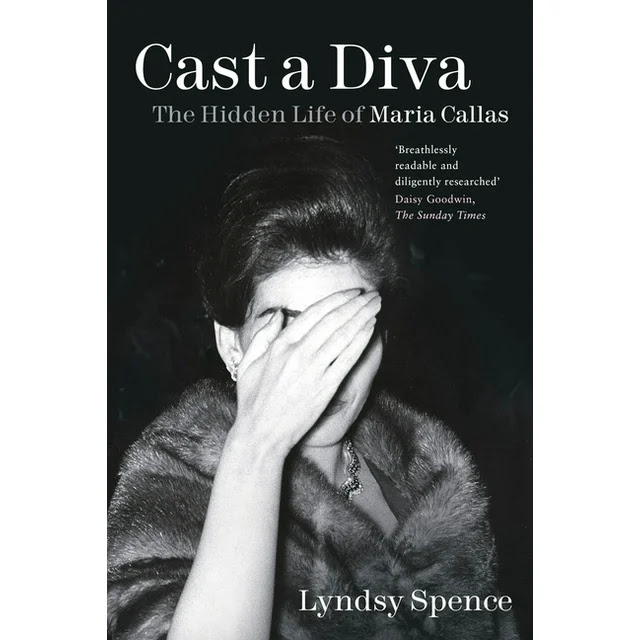
Cast a Diva - The Hidden Life of Maria Callas by Lyndsy Spence, is not the first book I found interesting by author Spence. She also wrote a book about Doris Delevingne called The Mistress of Mayfair, which I reference here when I elected Doris to be Mistress of the Month in August of 2018. This month however, I will be posting based on chapters as I'm listening to the audiobook while also taking notes. Cast a Diva is reviewed on various book sites on the Internet as presenting Callas as a feminist icon; wonder if I will agree with that notion? That said, Maria Callas has also been associated with tragedy - personally and publicly.

Image from Wikimedia
I think Maria Callas was distinctively beautiful.

MARIA CALLAS

Maria Cecelia Sophia Anna Kalogeropoulos

1923 (New York) - 1977 (Paris)

The early years of the life of Maria Callas were not easy or simple and had a profound effect on her psychology. Her parents were Greek immigrants to New York City in 1923. Maria's pharmacist father had career difficulties as an immigrant and her parents did not get along. It's suggested that her father was a womanizer or that her mother, "Litsa" thought herself and her family to be above his in status. Maria's mother decided that her two daughters were essential to her survival and the three of them went back to Greece in 1937, basically ditching her husband and their father. So Maria had little to no parenting by her father from that point. Her husband, Giovanni Battista Memeghini was an older man, and so was Aristotle Onassis. I can't help but wonder if she was vulnerable to older men because her father was so distant.

Maria's mother was emotionally abusive to her and there were serious questions about her mental health with suggestions that she was unstable, a narcissist, had borderline personality disorder or even schizophrenia. A brother had died and her mother wanted another son so Maria was an unwanted daughter. Maria had an older sister, Yakinthi, and their mother forced the girl into a relationship with a man, to become a Mistress to someone who would not only Keep her but financially help the whole family. This man supported all three of them for some time. This sacrifice on her sister's part also lead to a tangled and difficult relationship between Maria and her sister. With career success, Maria Callas found herself supporting her mother, and contributing to the support of her father and sister as well. They cared little for her personal happiness.

It could be said also that Maria's mother believed in her and promoted her as a child and had the ambition that Maria would someday support them all and free her sister from a dutiful pairing. Mother recognized that her daughter, Maria, had exceptional singing talent. Her mother begged for singing lessons for Maria, demanded she give her all to practice, and she allowed Maria to go without any education past about the eighth grade. No doubt in my mind is that this lack of education and constant focus on vocal training instead of academics was part of the deep insecurity Maria felt. In 1939 Maria Callas began to study at the Athens Conservatory and the perfectionist Maria had a fabulous career for some time.

Perhaps though, it was Maria's weight, along with the fraught relationships she had with her mother and sister, that caused the Opera Diva even more emotional issues as a young woman. The Diva was self-conscious of her myopia and acne, and it's said that she only felt loved while singing. Yet, Maria tapped into her wild range of emotions and feelings as an opera singer, and was unafraid of having an "ugly" voice if it was appropriate for the mood of a song. It was her ability to interpret the drama of a scene that, along with her exceptional voice, brought the audiences to tears and ovations. She said she wanted her voice to reflect "the atmosphere and thousands of colors."

Maria Callas married a rich industrialist, Giovanni Battista Meneghini, and was married for a decade from 1949-1959 to this husband who acted as her agent and manager. The Italian divorce laws at the time would make it near impossible for her to escape this marriage and this man's machinations. Like her family, in particular her mother, he proved to be only interested in her career and the fame and money that could buy them a good life.

There was Maria and then there was Callas, a private woman and a celebrity. She disagreed with feminism and the end of gender roles. "I failed to fulfill myself as a woman" she said, referring to her desire to have a child never fulfilled. 

During this month, I will not focus on the details of Maria Callas' opera career, though I realize that many a opera fan or Maria Callas fan is interested in those details. I assure you that the book does follow her career closely. For our purposes here, we want to focus on her relationships with men, and how it is that she chose to remain faithful to the unfaithful Aristotle Onassis. How is it that she was considered his mistress?  Was it simply because he would not marry her?  Because she clearly could support herself well but he was richer? Was it his attitudes towards women in general, which most modern women would find to be revolting? Her relationship with Aristotle Onassis, whom she called "Aristo" was an extreme example of emotional and psychological abuse and domestic violence. Years went on in which an Italian divorce was not granted. Both Aristo and Maria at times lied to the press that they would marry and then claimed they were joking.

Maria Callas died at the age of fifty-three after a life typified by the highest highs and lowest lows. It's quite possible that using a certain drug illegally - though is some parts of the world it was legal - meant a slow suicide. She had withdrawn into her apartment, was estranged from her family and husband, and after her death her mother, sister, and husband would split her clothing and furniture among themselves.

Stick with me as we learn together about the life of this stellar personality and talent, through the vision of author Lyndsy Spence!

C 2024 Mistress Manifesto BlogSpot   All Rights Reserved including Internet and International Rights.

You may find other posts by searching for Onassis in the Google Blogger search feature!