There were those who were opposed to it being built.
"It was at the 1889 Exposition Universelle, the date that marked the 100th anniversary of the French Revolution that a great competition was launched in the Journal Officiel."

Around this time Natalie began to further define her sexuality and the role she would play in seductions. She embraced her lesbianism and also realized that she could not be faithful to just one woman, that she craved variety. She became a seductress and began to proposition women she found attractive, even approaching strangers. If the woman said no firmly, Natalie would let them alone. If the woman seemed a little hesitant to reject her, she would go into full-on pursuit mode, sending flowers and poetry, doing whatever she could to wear down that person's resistance. However, once she succeeded, she lost interest.
That was not the case with Liane de Pougy, who she pursued strategically, watching the procession daily until it appeared that the latest reported conquest had gone his way. Natalie disguised herself first by using the name Florance Temple Bradford so that she could remain a mystery. She sent flowers daily and little notes to intrigue the woman into meeting her. When finally, the day came to reveal herself and meet Liane in person, she arrived dressed in a costume of a Knight, there to rescue a damsel in distress. Was Liane in need of rescue?
Natalie was still corresponding with her unofficial fiancée Robert Kelso Cassatt, and he too was enabling Natalie's affairs, helping her sneak around. Natalie was always looking for places she could meet women to have sex since she was still living with her parents. Cassatt was heterosexual and at one point she even went with him to the Folies Berger and Maxims to select a prostitute for his satisfaction. However, an experience that challenged that notion that he could accept a White Marriage with her occurred. The other woman arrived to their private dining area in a restaurant where the waiters knew to leave the food aside and stay away. Though he immediately left, he could not resist watching. She later blamed him for doing so, but the man was shaken.
Natalie wanted Liane to leave the Courtesan life. Liane's friends, especially her mentor Valtesse de la Bigne, were opposed to that idea. Valtesse reminded Liane that a Courtesan could have a few weeks with another woman, but she risked losing clientele. There was always someone else ready to take her place as the number one Courtesan in Paris.
At the time there were about forty successful, rich Courtesans who were well known by the public -celebrities. Liane was called The Divine, The Queen of Love, The Pearl, and the Sultana of Sex. Her image was in photos, on postcards and posters. She was in the press.
Liane was considered regal, elegant, intelligent, and accomplished. She spoke English and Spanish as well as French fluently. She also played the guitar and piano well and rode a horse with style. She had no talent for acting or singing but her presence in a production meant a sold-out house. She would eventually write seven novels that were not considered to be literary, but they sold, and one play as well as her My Blue Notebooks, a diary. Could she really give his all up?
Natalie thought so. She realized though that she would have to support Liane financially. She was still getting handouts from her father. What she was supposed to do is get married and get her dowry. Going against her principals, she wrote to Robert Kelso Cassatt and said she was ready to marry him. She never heard back. He had moved on and married a heterosexual woman.
Liane published a book called Idylle Saphique, a tell all about her affair with Natalie. Natalie knew about the book having read drafts and contributed a chapter. The book, published in 1901, had all the real people's names changed to protect the guilty, including her own name and Natalie's. However, the public was wise to who was who. Natalie wasn't entirely happy with the book's depiction of her, yet she gave out copies of it for years.
Finally, the rumors were so strong that Natalie was lesbian that her father heard about it. He was enraged and made her promise she would never see Liane again.
C 2022 Mistress Manifesto BlogSpot
All Rights Reserved including International and Internet Rights
The primary reference for this post is Wild Heart by Suzanne Rodriguez. My notes were taken especially from pages 74, 75, 87, 90,100-101. It's a wonderful book!

After her death in 1910 at the age of 62, the famous old courtesan, Valtesse De Bigne not only gave herself a decorative grave, but her estate held some beautiful antiques and paintings that were selectively given to her friends.
Courtesans of Paris often had a child somewhere in their youthful past, often raised by others, while they sent money. My observation is that the child was usually from a very early relationship, and that somehow these women managed to avoid further pregnancies. It is unknown to me, but I speculate that they may have also denied having any children to the men who they had affairs with. If you read Mistress Manifesto BlogSpot, you know that these relationships varied, that some courtesans had many, some had one at a time, and the definition of Courtesan varies. I always wonder who in the family knew about the child and if the child grew up to know its mother or even know her reputation or if that child admired its courtesan mother.
Valtesse's own granddaughter took the letters that Liane de Pougy had sent to Valtesse and she sold them. (Page 293) My guess is that she read them. That she did come to understand some things and might have been inspired.
Perhaps you watch The Crown, as I do, and you caught the way Prince Phillip was depicted, a boy alone sent to a rather, in my opinion, brutal school, where team work was emphasized. After the devastating loss of relatives due to a plane crash, it would seem that his mother, who had been mentally ill and received treatment in a hospital, joined a nunnery. His father was not much in his life. His father was with his Mistress in Monaco.
Guess who Prince Phillip's father, Prince Andrew of Greece, had as a Mistress in Monaco!
Comtesse Andre de la Bigne, as she called herself was the grand-daughter of Valtesse de la Bigne.
She deserves a month all to her own here, so I'll stop with that teaser here...
C 2022 Mistress Manifesto BlogSpot
Our primary reference for this month's subject, Courtesan Laine De Pougy, is the book titled the Mistress of Paris by author Catherine Hewitt. Additional information comes from other sources, such as, for this post, wikipedia.

Her life intersected with some other women we have covered here including the Valtesse de la Bigne, who faked a noble heritage and ended up rich, in April 2018, and American lesbian in Paris, Natalie Clifford Barney, in September 2014.
She was a Courtesan who chose as an adult to start at the middle and made it to the top. But was she happy?
I got hooked on Emily in Paris last year, and just binge watched the second season. If anything the show is going a bit slow for me; I'm ready for the third season and don't want to wait. Am I a fan? Well...
My first impression was that the writers were highly dependent on stereotypes of the French, especially the comparatively accepting attitude about sexuality outside of marriage compared to most Americans. That's why I'm posting this here at MISTRESS MANIFESTO BLOGSPOT. There are just so very many Parisian Courtesans to cover, and though few modern women in this world live lives comparative to the Belle Epoch Courtesans, you can use the search feature in this blog to discover just how important France is to our subject. You can muse along with me. There isn't just lots of sex outside marriage and other seemingly committed relationships in this show, there is a blurring of the boundaries about what's personal and also what is unacceptable sexual harassment on the job.
Emily is a modern American girl, from Chicago, who also seems to have an unlimited budget for Paris fashion, some of it by my way of thinking quite unprofessional for the office. Also she seems to be happy most of the time and is constantly chronicling her adventures using her social media and personal cell phone to take photos proving it. With that I figure she has little sense of privacy.
But OK, it's a fantasy that a girl who just graduated college working for an American marketing firm, could get this paid experiential or whatever it is she's doing at the firm, live in a small apartment - that she shares with the richest girl in China who is estranged from her family and busking - and afford all those clothes. Maybe they're gifts from some of the client companies? She is cuteness unlimited, bopping around, and really making the most of her French experience. She manages to get on the nerves of her woman boss - a woman of a mysterious age but let's say she's 40-something and still hot. The work crew includes an openly gay black man who also wears loud colors like Emily does and also seems to otherwise be a stereotype of gay creatives. The office crew seem to go somewhere between agreeing with clients and influencing them to market, promote, and advertise their products and hone their reputations. Meanwhile there are some conflicts because of Emily's American values. She never means to, being exuberant and helpful and sweet by nature, but she can ruffle feathers not knowing what the boundaries are, and she still seems to be surprised at how open about sexuality the French are.
Except that, when it comes to sex, Emily is an adventurer who doesn't know what to make of a client sending her sexy underwear as a suggestion or what to do since she just had the best sex of her life with a good woman friend's special man. So much forgiveness though! Can Emily chose between the friendship and what she wants and needs for herself? And has this become the conflict of the show - to be a Parisian or remain an American when it comes to values? Last season she had sex with a teenager not knowing he was so young. His mother found out and approved. It happens.
Her American boss has come to visit the office and is quickly appalled by the idea that an employee would have an affair with a client. Where does Emily stand on this? Does she accept it as a team player at the company or because she is a peon in the scheme of things?
I've had coworkers who were involved with the married boss. They were unmarried women who were not in relationships. If everyone in the office didn't know it, they suspected it. And friends have fallen for someone at their job, jobs they intended to keep, and it was messy when it didn't work out.
On the lighter side, I laughed out loud at some of the antics of this second season. I anticipate that at some point in the show Emily is going to be called back to America and she is not going to want to go. Don't we all want her to find true love? Is refusing to have sex outside the relationship the test? Would the chef she had great sex with ever consider opening a place in Chicago?
C 2022 Mistress Manifesto BlogSpot
All Rights Reserved including Internet and International Rights.
Simone De Beauvoir, a feminist writer who became famous for a book called "The Second Sex," published in 1949 which is now considered a classic and revolutionary, called Cleo de Merode a Courtesan. A Mistress. A hetaeri. In The Second Sex the author examines how women have been treated throughout history. She got in trouble when she wrote that about Cleo was a courtesan. The old dancer, then about seventy-five, sued. By 1952 she had won and the defamation was removed from future printings..
Having had the admiration of many men, what would the beautiful ex dancer admit to? If not the King, then who? Was she rewriting her own history, saving face, or forgetting?
Like other women we've covered here at this blog, Cleo wrote and published a memoir. Hers, entitled "Le Ballet de Ma Vis" (In English, "The Dance of My Life,") came out in 1955. In it she admitted to having been involved with only two men in her life! Perhaps the woman, raised Catholic by her Baroness mother, was saying a lot to admit to two. Born illegitimate, she never married or had children.
The list of artists, sculptors, and photographers she posed for is long. It's not likely they used a body double. She no doubt wished to engage men's imaginations. She was seen nude, but perhaps it could be said artistically nude rather than pornography nude.
She wrote that for a decade, until he died in 1904, she'd been engaged with a French aristocrat. Then, she said she'd been the companion of a Spanish Diplomat from 1906-1919.
I do wonder if the woman actually went from 1919 to 1966 without ever another boyfriend. It seems anything us possible but it's my opinion she chose to admit to two long term relationships. In other words two men she thought worth writing about.
Cleo had enough money to the beach town on the southwestern coast of France called Biarritz which had once been a cool place for nobles to vacation. She lived to be 91 years old and as they years past became unknown.
C 2021 Mistress Manifesto BlogSpot
All Rights Reserved including Internet and International Rights
19th CENTURY ART WORLD : GARVAL'S ON DE MERODE
From an article called Cleo de Merode's which is excellent and gives us much information about society and culture in Paris, France, at the time when Cleo de Merode was coming up as a dancer and woman.
EXCERPT: During this period young dancers or petites danseuses loomed especially large in the collective imagination. The most coveted of all were the so called rats, the 12-16year old girls in the Paris Opera corps de ballet, an institution that, according to Lenard R Berlanstein, had a long standing reputation as a "national harem." Likewise, Willy's 1904 book on danseuses still characterized the Paris Opera as "a sanctuary for Venus's progeny, a libertine haven," subject of "a thousand salacious anecdotes. a thousand scandalous rumors. In this temple o licentiousness, the young girls of the corps de ballet were the not-quite vestal virgins, and the Foyer de la Danse, or dancer's lounge, the inner sanctum. Her only the wealthiest, most powerful en could enter, mingle with the dancers, and pursue those they fancied - as in the 1901 Steinlen illustration from L'Assiette au beurre - practices that amounted to a kind of "state- sponsored prostitution."
Go the article to see postcards of Cleo De Merode and more fascinating information including poetry that had been written about her as a beauty..
In the first post this month, I mentioned that the celebrity story of the Belle Epoch dancer Cleopatra "Cleo" de Merode, who modeled for artists and photographers and became known internationally, had much to do with postcards that were mailed around the world. She also gained publicity because she was supposed to be a favored Mistress of King Leopold II of Belgium.
This was the Belle Epoch in Paris, a time that might have been the best ever for the Courtesans, the woman who had their pick of rich men who gave them money, jewels, and gifts, if not in exchange for sex then in a relationship that most often included it. Ballet dancers were assumed to have patrons from a young age and to be sexual, graduating into Courtesans. Many a poor girl found this was a way to survive, though she might never marry. Some Courtesans started as singers or dancers. Some as prostitutes. It was a way of life that was tolerated, if not accepted, in Paris; some Courtesans became famous for their men.
Perhaps it was a bit difficult to know who was what.
Cleo's lifestyle lead to her reputation. She danced not just the more respected ballet but also at the Folies Bergere, considered to be the risque forte of the dancer.
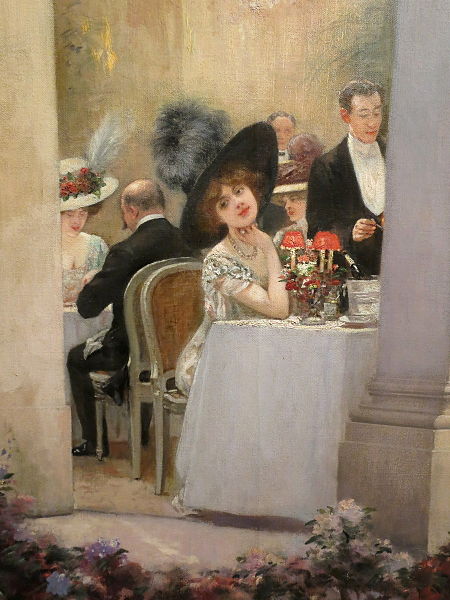
Courtesans were seen out and about around town with men, showing off the riches they had gained by dress and ornamentation. They were not hidden away. In this way both partners were showing off.
In 1896 Cleo was performing at The Opera Ballet as part of the perfomanace of Aida, and the King watched from his private box. He asked to meet her and she went to meet him and didn't come back quickly for the second act to begin. Of course the audience noticed that a half hour had lapsed before she returned to the stage.
Whatever did or didn't happen in that interlude - perhaps nothing more than a star-struck man having a conversation - that the two of them made appearances around town openly together gave the tantalizing rumors some extra flavor.
According to author Michael Garval, I note a century before Brangelina, there was Cleopold or Merodopold. In those days, I note before a person was a brand or could acquire money from allowing their images or name on products, Cleo de Merode's name was put on underwear, cigars, dolls, and other items.*
According to encyclopedia.com,
though both denied any improper relationship, their relationship lasted a decade and it was supposed that they'd had sex in his private Opera box upon first meeting.
The couple were lampooned in cartoons in which the King was portrayed as horny but also unfairly cheap and cold to his wife, daughters, and sister, because instead he bought jewels for Cleo.
According to Betty Klein, in her 1966 book "The Mistresses: Domestic Scandals of Nineteenth Century Monarchs," that Cleo was Leopold's Mistress was understood in Brussels. As well, the relationship was also acknowledged in other Royal Courts - in England, Russia, and Denmark. Though the King would've been 71 after a decade with Cleo, it was said he moved on to other extramarital relationships.
C 2021 Mistress Manifesto BlogSpot
*Michael D. Garval, in his book, "Cleo de Merode and the Rise of Modern Celebrity Culture," page 94. I'll be posting some strong direct quotes from this book later in the month.