Showing posts with label New Yorker - Book Review. Show all posts

Wednesday, September 17, 2025

MARIE DUPLESSIS MOVES INTO A BETTER APARTMENT : COUNT EDOUARD DE PERREGAUX

As Marie Duplessis moved up in the world, she attracted Count Edouard De Perregaux as a new love and perhaps he was the man she would come closest to becoming a Mistress of. His father was a financier who had been made a senator by Napoleon Bonaparte and was attached to the Bank of France. Edouard himself had been in the military in Africa and had earned a good reputation and inherited a sizable fortune but he also seemed to be determined to spend it and go into debt.

Excerpts pages 41 - 42 : He first encountered Marie at a masked ball at the Opera House in the rue Le Peletier, the tradition of masked balls having been revived there in 1839, such events being held every Saturday evening during the carnival time before Lent. Edouard and Marie were intregued by one another, and Edouard rapidly dropped another courtesan, Alice Ozy, in order to take up with her.

The apartment in which he installed her at 22 rue d'Antin comprised a drawing room, a boudoir, dining room and two bedrooms. The widows, and Marie's bed, were curtained with muslin and silk. Marie ordered her goods and services from a wide range of providers" wines from Madame Tisserant, just opposite in the rue d'Anton; cakes delivered by Rollet from the passage de l'Opera, glace fruits from Broissier, mint pastilles from Gouache in the boulevard de la Madeleine. Edouard would join in the consumption of all these luxuries, not stopping to make the calculation that by spending at the rate of three thousand francs a month, which was the absolute minimum Marie required to live on, he would rapidly use up his already depleted fortune. 


Marie felt flattered because Count de Perregaux seemed to be only interested in her but eventually also felt she had been deceived into thinking his fortune was substantial enough to last past her spending. He was estranged from his family and friends over his unrequited passion and extreme spending in order to keep her happy. She didn't cut him off completely but took on other lovers willing to keep her in the accommodations she desired. Considering his fixation on Marie, it must have taken some expertise to both disappoint him and keep him in her life.

At a time in which concerns about venereal diseases such as syphilis, for which there was no real cure, prevailed and during which contraception was limited, women especially paid the price for sexuality and pregnancy. But there was another disease that people feared and that claimed countless lives for which there was no cure and that was tuberculosis. Young Marie Duplessis must have realized she was seriously ill by this time as she was spitting up blood. 

Count Edouard de Perregaux is important to the story of this Courtesan though because towards the end of her life, as she was dying of tuberculosis, it was he who she married.

C 2025 Mistress Manifesto BlogSpot
All Rights Reserved including Internet and International Rights


Wednesday, July 14, 2021

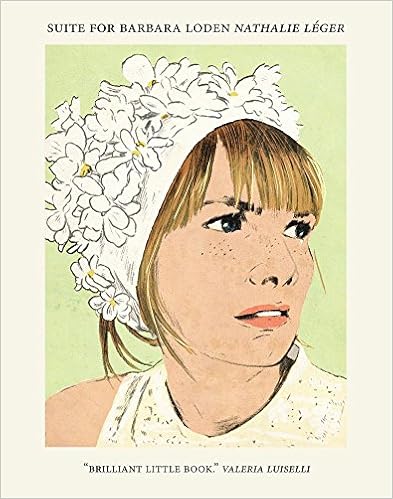
SUITE FOR BARBARA LODEN by NATHALIE LEGER is a MULTI GENRE MASTERPEICE

Image result for suite for barbara loden The book was authored by French writer Nathalie Leger.


This is an excellent review of the book, which was an accomplishment of Nathalie Leger.  The author had difficulty in researching Barbara Loden.  Sadly the Elia Kazan archives do not contain anything about his second wife.

EXCERPT :  Here, now, is a remarkable new book that does everything - biography, criticism, film history, memoir, and e3ven fiction, all at once, all out in front.  The book is "Suite for Barbara Loden," by French author Nathalie Leger, which was originally publishe4d in 2012 and is recently out in English translation from the small press Dorothy.  It's all the more remarkable for doing so much in a mere hundred and twenty-three pages (in translation by Natasha Lehrer and Cecile Menon). Barbara Loden direct3ed one feature film, "Wanda" from 1970, in which she also starred.  She was already an actress, including  in "Wild River" and "Splendor in the Grass," both directed by Elia Kazan, whom she married in 1968.  She won a Tony Award for her stage role in Arthur Miller's "After the Fall," from 1964.  But Loden's place in artistic history is assured y "Wanda," one of the best American independent films ever made.  She had other projects in minds (including an adaptation of Kate Chopin's novel "The Awakening" but was unable to find financing for them.  She died of cancer in 1980, at the age of forty-eight.